The Business of (and for) Peace

Reflections from the World Economic Forum Annual Meeting January 2024, held under the theme: Rebuilding Trust. 
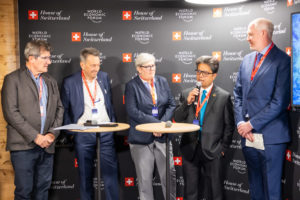
Liam Foran, CEO, Peace Dividend Initiative speaks about the need for peace-supporting investments during the Annual Meeting of the World Economic Forum.

A better calibration of entrepreneurs, businesses, and investors in frontier markets can help shake off the doom and gloom of global fragility and build a safer world.

Although conflict is on the rise, at the grassroots in many countries bearing the brunt of violence there is a surprising amount of hope, resilience, and entrepreneurship.

Decades of international development spending on skills and education combined with the global reach of value chains has lifted billions out of poverty. Internet and smart phones have further accelerated this process creating a generation of “micro-multinationals” – small to medium sized businesses hungry to participate in the global economy.

But the success of co-opting much of the world into economic aspiration has a dark side, if these aspirations go unfulfilled, or entrepreneurs are restricted from participating in the market, conflicts can spark.

One of the big problems we discussed this week is that entrepreneurs in conflict zones lack access to capital, global business networks and markets. Current economic mechanisms designed to stabilise conflict zones provide little long-term employment and resulting stability.

Aid is not an investment tool, and donor funds are notoriously bad at job creation. Livelihood projects promoted by development agencies are often too small to help entrepreneurs build big enough businesses to exert a stabilizing influence on their surroundings.

Large pools of capital in development finance institutions are designed to build big things like roads, airports or agro-industrial businesses, and struggle to transact deals less than $20m in size.

In our experience the real impact is in smaller deals, between $500k and $5m. This is where talented local entrepreneurs are building businesses that exert stability in fragile communities. Creating employment and income growth that provide powerful economic incentives for communities to move away from violence and towards peace.

The precursor elements have all been built, but the mechanisms to connect aspirational entrepreneurs working in fragile countries to investors are not functioning properly. So, there is a missing middle, and this represents a huge opportunity.

The Peace Dividend Initiative’s response is to bring venture capital models to places underserved by investors. Focusing on building incubation pipelines and then investing in deal sizes between $500k and $5m through our Peace Venture Fund (PVF) mechanism.

But PDI is just one small emerging actor, the real gamechanger to make the world more stable, would be for private sector actors to begin engaging coherently in peacemaking.

There are countless examples of where the private sector has been able to support and secure long-term peace; from the reconstruction of Europe after the World Wars to foreign direct investment in Northern Ireland to tackling Kenyan election violence, when the private sector acts in concert with peacemakers, the results can be impressive.

Shockingly at a time when conflict is on the rise, both public and private investment in peacemaking is at historic lows – with the most underinvested Sustainable Development Goal (SDG) being number 16 – whose goal is to “Promote just, peaceful and inclusive societies.”

The last few years have been a stark reminder that a clear business case to invest in peace exists. With attacks in the Suez Canal shipping area contributing to global inflation, the war in Ukraine affecting food prices around the world, and the cost of crude rocketing due to conflict in the Middle East.

In response PDI has been engaging business leaders at this year’s World Economic Forum to discuss how the private sector can respond to the alarming re-emergence of conflict. There is a serious willingness to engage, probably the most serious in decades as business feel the tangible impact of war on their balance sheets.

But what can businesses do to support global peacemaking?

We suggest three clear actions.

  1. Participate in Economic dialogues in support of peace.
    • There are currently about 30 active major peace process taking place, led by a constellation of states, UN agencies and private peace mediators. These overwhelmingly involve political actors. We must include more economic actors at the early stages in these processes and develop economic plans to support and secure the ceasefires and peace agreements negotiated.
  1. Incubation of peace supporting businesses in conflict affected areas.
    • There are entrepreneurs in every corner of the planet, with good ideas and a willingness to work hard to leap out of poverty and fragility. Much reporting on conflict zones focuses on the grim aspects, and this misses the many inspiring and resilient people on the ground, who have remarkable courage in building businesses in the face of so much adversity. They are not looking for handouts but guidance in developing their products and services and the chance to compete fairly in the market. They need private sector partners to help them get started and scale.
  1. Peace supporting investments.
    • Impact investing is making serious gains in areas like sustainability, education, and housing. But there is no major effort yet to channel private capital towards helping secure long term and sustainable peace. But it is coming, we, along with several other actors have developed the +P framework to guide investors towards securing peace outcomes. It can be as simple as investing in businesses that employ former combatants or employ former adversaries to work in the same team.
    • We are also aiming to raise $100m for our Peace Venture Fund (PVF) in 2024 and deploy this capital to grow businesses in conflict affected areas.

We are looking for partners to help scale this work.

If you would like more information or have an idea for where we might work together, please contact us.




The Peace Dividend Initiative and Symbiotics Announce Partnership to create the Peace Venture Fund, the first impact fund investing in peace-supporting businesses.

Geneva, 3rd October 2023 – The Peace Dividend Initiative (PDI), a not-for-profit foundation dedicated to harnessing market forces for peace, and Symbiotics, the leading market access platform for impact investing, today announced the Peace Venture Fund, a partnership between the two organizations to invest in peace-supporting businesses and support entrepreneurs in fragile and at-risk countries.

As a quarter of the world’s population, representing 2 billion people, live in conflict-affected areas, SDG 16 (Peace, Justice, and Strong Institutions) remains one of the most underfunded Sustainable Development Goals. To date, the main form of private sector engagement in peace-making has been philanthropic, and for a minimal amount – the global annual funding for peacemakers is around USD 200 million and represents less than 1% of philanthropic donations.

The Peace Venture Fund (PVF), the first of its kind, will adopt a venture and impact investment approach to encourage entrepreneurship in fragile and at-risk countries. It will allow a quick deployment of private capital in areas otherwise ignored by traditional market mechanisms. The PVF leverages PDI’s access and expertise in business creation and development in fragile contexts and Symbiotics’ experience in impact investing in frontier markets.

The PVF aims to deliver a peace + profit return over 7 to 10 years, with the peace impact being assessed and tracked by the innovative +P framework. The +P developed by PDI blends 20 years of peace-making impact measurement with classic business metrics to allow a flexible system of ensuring businesses within the PVF are and remain peace supporting.

Through partnerships with peace mediators and deep and trusted access in fragile and at-risk areas, PDI has been leading the charge in supporting entrepreneurs and creating innovative and field-tested ways to design and deliver peace-supporting investment, ultimately seeking to harness market forces for peace. Offering investment, asset management and capacity building services, Symbiotics is a global leader in impact investing, dedicated to private markets in emerging and frontier economies.

“Over the past years, we have seen tremendous entrepreneurial potential in the countries where we operate, and ventures with the true potential to re-shape socioeconomic dynamics in favor of peace. Unfortunately, those entrepreneurs, many of whom are the most innovative and resilient one could meet, are unable to access capital to grow their ventures. We are very excited to partner with Symbiotics to create the Peace Venture Fund and provide support to peace entrepreneurs. The Peace Venture Fund provides investors and financiers with a new avenue to sustainably create a lasting peace-supporting impact, while gaining valuable access to developing markets.” said Liam Foran, CEO of the Peace Dividend Initiative.

“Symbiotics is very pleased to have been chosen by PDI as the preferred investment manager and fund management company for this exciting and innovative public private partnership. We strongly believe that investing in conflict-affected areas can support peace-building and peace-making momentum. The fund is a one-of-its-kind, addressing directly SDG16, which hopefully will boost capital flows for such an important sustainable investment objective. With our footprint in 95 emerging and frontier economies, and our strong investment infrastructure and practice, we look forward to making this happen with PDI.” said Roland Dominicé, Managing Director of Symbiotics Group.


About the Peace Dividend Initiative

The Peace Dividend Initiative (PDI) is a peace-dividend accelerator dedicated to harnessing market forces for peace. PDI bridges the gap between peace mediation and economic actors through dialogue, incubation, and investment.Headquartered in Geneva as a not for profit foundation, PDI is connected to peacemakers, international organisations, governments, investors, and entrepreneurs. peacedividends.org


About Symbiotics

Symbiotics is the leading market access platform for impact investing, dedicated to private markets in emerging and frontier economies. The group offers investment, asset management and capacity building services. Since 2005, we have originated over 7,501 investments representing more than USD 9.4 billion for 575 companies in 95 countries. We manage an aggregate portfolio of USD 2.9 billion spread across 23 funds and mandates. Our portfolio companies have also benefited from over 145 technical assistance projects worth more than USD 18 million. symbioticsgroup.com


Contact

Julie Mandoyan, Head, Incubation and Strategic Partnerships, Peace Dividend Initiative

julie@peacedividends.org


Samy Derradji, Head of Corporate Communication, Symbiotics

samy.derradji@symbioticsgroup.com


Charting a Course for Peace-Impact Investing

For the United Nations (UN), the year 2020 marked the beginning of a new era of conflict and violence, characterized by a proliferation of entrenched conflicts among non-state actors, an ever-present threat of terrorism, and soaring rates of urban, domestic, and gender-based violence. Since the release of the 2020 report, the gravity of these trends has been compounded by Russia’s invasion of Ukraine, and by growing geo-economic competition globally between democratic and autocratic states. More than ever, the time is right to invest in peace. And yet, peacebuilding and peace mediation budgets remain chronically underfunded, fragmented, and heavily reliant on scarce public funds. In response to these troubling features of the international landscape, UN Secretary-General Antonio Guterres urgently called for a deeper investment into peace and peacebuilding in his March 2022 report to the UN Peacebuilding Commission.

The emergent field of peace finance is a response to this imperative. The early proponents of peace finance have focused mostly on new financing mechanisms to catalyse additional private funding towards peacebuilding, tying the success of peace-building efforts to the improved risk-profile of proposed investments. Advocates of peace finance point out that the risk of investment decreases as the level of conflict decreases, and that investing in peace mediation or peacebuilding offers an effective way of de-risking project finance, ultimately increasing the return on investment.

However, there are significant hazards hidden in these ‘peace finance’ or ‘private sector development’ waters. Simply increasing funding for peacemaking while increasing the flow of private capital into conflict-affected areas will not be sufficient. Analysis across multiple sectors has shown that large-scale investments sometimes have a tendency to exacerbate conflict, and even well-intentioned and carefully targeted investments can produce unwanted effects if delivered in a ‘set-and-forget’ manner following the initial due-diligence phase. The reputational risk of merely token efforts towards peace-impact investing will be evident to readers familiar with the ‘green-washing’ of supposedly sustainable investments, and the resulting challenges confronting the ESG impact investment agenda.

Rather than simply ‘throwing money at the problem of conflict’, investors and financiers seeking to create an impact for peace must consider how to understand and address the systemic roots of conflict, and how to remain adaptive over an entire investment life-cycle, in response to highly dynamic and complex conflict settings.

Organisations such as the Peace Dividend Initiative (PDI) have been leading the charge in creating innovative and field-tested ways to design and deliver peace-supporting investment, ultimately seeking to harness market forces for peace. PDI pursues this aim by addressing three strategic questions when designing and delivering peace-supporting investments in conflict-affected areas:

  1. Can the prospect of private investment create fresh opportunities for peace dialogues at the local or state level?
  2. Can innovative approaches to SME business incubation help promote peace-supporting livelihoods and networks?
  3. Can private investment help accelerate and establish sustainable economic incentives in favor of peace for private, public and community actors?

PDI works by aligning key public and private sector actors on cutting-edge peace-supporting investment innovations and approaches. The Peace Venture Fund (PVF), a dedicated investment fund currently incubated within PDI whose work spans a wide range of fragile and at-risk (FAR) countries, exemplifies this groundbreaking cross-sectoral approach to investing in peace.

PDI’s groundbreaking work in promoting peace-supporting investment is sorely needed: SDG 16 (Peace, Justice, and Strong Institutions) remains one of the most underfunded Sustainable Development Goals.  One key reason for this is likely the lack of understanding to date around what constitutes ‘peace impact’. What does it mean to invest in peace? How do we integrate a peace lens into the investment lifecycle? In many ways, the current state of the peace finance landscape is not dissimilar to the situation when Environmental, Social, and Governance (ESG) was first coined as a concept in 2005. Indeed, there was little understanding and limited adoption of ESG as a concept till the release of the UN Principles for Responsible Investment (PRI) report in 2006 which explicitly discussed the incorporation of ESG criteria into investment analyses and decision-making processes. In 2006, about USD 6.5 trillion in assets under management were associated with formal ESG commitments made by signatories to the PRI. By 2019, this figure had exploded to over USD 80 trillion.

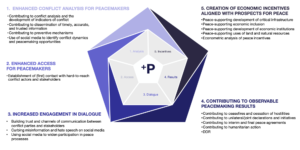
Here, we present an important first step towards a more concrete understanding of what it means to design and deliver peace-supporting investment or ‘peace-impact’. Work on the +P framework, initiated by PDI since 2018, has generated a set of guidelines and recommendations for integrating peace impact as a core consideration in each stage of the investment lifecycle, from due diligence to exit. Much like the initial groundwork that was laid by the UN Global Compact Report and the Freshfield Report, the ambition of the +P framework is to act as a springboard for further and more in-depth discussion on peace-impact, or +P investing.

The +P framework has its roots in best practice learnings from leading peace mediation and peacebuilding organisations, and can be applied to a range of macro (conflict-level) and micro (firm-level) contexts. Its name, the +P, indicates its intended coherence and usability alongside other existing ESG and impact-measurement approaches.

+P framework © Peace Dividend Initiative


The +P framework is intended to mobilise investment in support of peace by addressing the social, economic, and political drivers of violent conflict. This evidently requires a close knowledge of local conflict dynamics, and the +P criteria would allow investors to receive guidance from trusted peace-making partners, ensuring that the investment remains authentically peace-supporting. The +P framework also leaves room for the development of specific key performance indicators (KPIs) and more detailed and context-specific criteria, metrics and sub-metrics to track and measure peace impact at a firm- and portfolio-level. They are highly adaptable, based on the needs of the investor seeking to adopt a +P lens in their investment approach, and the availability of data fit for quantitative analysis and machine learning.

Charting the arc of the ESG’s phenomenal cross-industry adoption, the hope is for these guidelines to jumpstart the discussion around +P investing, and to guide the efforts of first-movers and innovators committed to a sustainable future for peace.

In 2023-24, PDI will be working iteratively with leading peacemakers, investors, researchers, and grassroots entrepreneurs in fragile and at-risk areas to pilot and adapt this initial framework, and to develop peace-positive investment guidelines, criteria and indicators. We welcome new partnerships in deepening and broadening this work.


by Dr. Ian Wadley, Founding team member and Executive Advisor and Rosalind Tan, Advisor, Venture Investment, PDI, with thanks to Dr. Achim Wennmann, Executive Advisor for Research and Insights, PDI, for his feedback.


Photo by Nataliya Vaitkevich on Pexels.

Jungle of Peace: How a chocolate business run by ex-FARC fighters is delivering economic dividends to communities in Colombia

Para leer la versión en español, por favor siga este enlace.

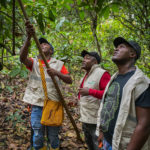
For many years, Asdrúbal and Segundo lived and fought in the rugged jungles of southwestern Colombia as members of the FARC guerrilla group at war with the state.

Now, in those same jungles around Meta and Tumaco, they are turning cocoa beans into gourmet chocolate bars to create livelihoods for their communities and heal the wounds of the past as Colombia seeks to build on the 2016 peace deal ending five decades of conflict that killed 260,000 people.

Under the brand Manigua de Paz (Jungle of Peace), the project brings together nearly 100 former combatants of the Fuerzas Armadas Revolucionarias de Colombia (FARC) across two sprawling cocoa cooperatives. The two areas are among the most vulnerable in Colombia and remain dangerous with the presence of various armed groups.

“The hands of the ex-guerrillas are not only made to use weapons but also to work on something very special like cacao, which for us is love, life and peace,” said Segundo, who is part of the Nueva Esperanza del Pacífico cooperative in the coastal city of Tumaco. “That gives us the capacity to generate future employment for the communities and to leave a legacy for our children.”

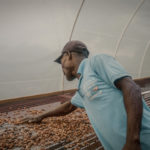
The cooperatives control every step of the process – from growing the beans to overseeing production of four varieties of chocolate made with 70% cacao. The packaging was designed by the communities themselves with images and colours that represent their culture and environment.

“We were involved in a military track and now we have moved on and live a totally democratic life,” said Asdrúbal, from the Judío Errante cooperative in Meta. “We put down our weapons and we are thinking about different things, such as looking for a way to live with dignity and economic sustainability.”

The bean-to-bar business – incubated by the Centre for Humanitarian Dialogue (HD) and the Peace Dividend Initiative (PDI) since 2020 – has big plans for its organic chocolate.

The bars are already sold directly by the cooperatives but Manigua de Paz aims to start expanding into retail outlets in Colombia this year to reach a potential market of 52 million residents and the 4 million tourists who visit each year. Online sales and a push into Europe are also in the plans.

“From humble beginnings, Manigua de Paz is a clear and encouraging sign of success in harnessing market forces for peace in Colombia’s still fragile environment,” said Judyta Wasowska, HD’s regional director for Latin America and the chair of PDI.

“It helps to connect the promise of peace with sustainable income and foster trust among communities – with an economic dialogue – so they can move beyond many years of conflict with real opportunities for cooperation and development.”

On top of the livelihood dividends, the project aims to change negative perceptions around former FARC combatants, to reduce the risk of them returning to violence and – by enhancing investment in the region – to transform the one-sided narrative around Colombia and its conflicts.

“Creating a viable business in Meta and Tumaco is a testament to the hard work the communities have done and the risks they’ve taken,” said Liam Foran, the chief executive officer of PDI.

“Just as Manigua de Paz is adding value by making finished chocolate from cacao, it’s also shifting the narrative and perceptions from generations of conflict into sustainable and ethical businesses that will help to lock in long-term peace for Colombia. Together with our mediation partners, this successful project gives us confidence about expanding our innovative approach to other areas of the country.”


Produced by HD and PDI, 2023

Video credit: Gianni Camporota